

People feel sad, irritated, or anxious from time to time, and it is normal. However, some individuals experience these emotions with extreme intensity. The intense reactions are known as emotional dysregulation, which is part of many mental health conditions like anxiety disorders, depression, and especially borderline personality disorder.
Dialectical Behavior Therapy (DBT), or Talk Therapy, was initially introduced to manage these intense feelings and reactions. The certified psychologists at Capital Psychiatry Group offer DBT therapy (online & in-clinic) to address diverse cognitive & psychological needs, validate reactions, and help you manage emotions effectively.
Break the Cycle With DBT Skills
If the same emotional patterns keep repeating, DBT can help you find relief. Through structured skills and support from our DBT therapists (online & onsite), you can learn how to respond calmly when emotions rise.
What Is Dialectical Behavior Therapy (DBT)?
Dialectical Behavior Therapy (DBT) is a kind of psychotherapy that helps regulate extreme emotions and cope with unwanted/reactionary situations.
DBT was originally developed by Marsha Linehan as a multiproblematic therapy for women experiencing chronic suicidal ideation and self-injury, especially borderline personality disorder (BPD). Over time, DBT has been adapted for many conditions, including anxiety, depression, and other emotion-related disorders.
Expert Insights
- Marsha Linehan realized CBT is focused on cognitions and behaviors, which often leave sensitive patients feeling criticized, misunderstood, and invalidated.
- She developed DBT from cognitive-behavioral therapy with a core focus on not just changing behavior but also validating patients emotional responses and perspectives.
Who is DBT For?
Originally developed to treat BPD. Now, research and clinical practice have expanded, and DBT is used to manage symptoms of multiple mental health conditions.
Conditions and Difficulties DBT Is Commonly Used For
- Chronic suicidal ideation and self-injury (even outside a formal BPD diagnosis)
- Emotionally unstable personality traits
- Depression
- Bipolar disorder
- Substance use disorders
- Eating disorders
- Post-traumatic stress disorder (PTSD)
- Adolescents with self-harm, mood instability, or high-risk behaviors
How is DBT Different from Cognitive-Behavioral Therapy?
Dialectical means two things can be true at the same time. In DBT, the core is that your reaction was valid from your side. That is what makes it different from cognitive behavioral therapy. In cognitive behavioral therapy, a therapist will help you understand how thoughts affect behavior and emotions, but in dialectical behavioral therapy, they will validate your behaviors/feelings/realities and help you change your thinking and behavior.
The core is to have a balance between acceptance and change. This is what DBT looks like:
- Your feelings make sense based on what you’ve been through.
- You can learn new ways to manage your reactions and emotions wisely.
Support for Repeated Emotional Crises
If conflicts, shutdowns, or emotional instability keep happening despite your best efforts, CPG therapists can help you (online & in-clinic) manage those patterns. Treatment (therapy, counseling, medication) focuses on practical skills that improve emotional regulation during difficult moments.
Why Do I React Like This? The Biosocial Theory
When you combine that sensitivity with the environment, you will find moments when you don’t know how to respond, whether because of criticism, dismissal, or simply not understanding. This may develop emotional patterns that remain with the person even in adulthood.
This is called the biosocial theory:
- Biological sensitivity: your nervous system reacts quickly and intensely.
- Social environment: the people around you didn’t teach you how to handle those reactions because they didn’t know how themselves.
Over Time, this Creates a Cycle
- You feel everything strongly.
- Someone downplays or misunderstands your emotional sensitivity.
- You learn that your emotions are “too much.”
- You try to hide them, then they build and spill over.
Perspective of an Adult with Emotional Dysregulation
- “I react before I even understand what I’m reacting to.”
- “When I’m upset, it takes hours to feel normal again.”
- “I know my reaction wasn’t the best for the situation, but I can’t stop it.”
The patient responds quickly and emotionally to sad and exciting events, words, and affirmations. And because the patient’s brain chemicals react so intensely, it is natural that it takes time to calm down.
The Four Pillars of DBT
DBT teaches four sets of skills that don’t erase emotions but help you understand them. It also teaches you how to regulate emotions and respond in ways that bring peace and stability.
1. Mindfulness
Mindfulness is being aware of what is going on in the present without judging it or trying to change it. In mindfulness DBT, you learn to evaluate the situation in many parameters before responding instantaneously.
During an intense reactionary emotional episode, you may immediately jump ahead of reality.
- A delayed text becomes, “He must be mad at me.”
- A disagreement becomes, “I ruined everything again.”
- A vulnerable moment becomes, “I’m stupid for feeling this way.”
You notice:
- “I felt a shift.”
- “My chest tightened.”
- “My mind jumped to the worst-case scenario.”
Mindfulness is about absorbing the situation, taking a step back, and realizing:
“This is a thought based on my personal hunch. I don’t have to act on it right now.”
Stuck in the Same Emotional Cycles
If emotional reactions interfere with relationships, responsibilities, or decision-making, DBT provides tools to improve regulation and reduce the impact of intense emotional responses via telehealth & in-clinic care.
2. Distress Tolerance
It’s important to remember that uncomfortable situations are a part of life, and they can’t always be avoided and fixed with simultaneous reactions. During stressful moments, you might say things like:
- “I need this feeling to stop right now.”
- “This feels overwhelming, and I don’t know how to cope.”
- “My emotions feel too intense to manage.”
Distress tolerance skills in DBT are designed for situations like these. It helps patients endure emotional pain without acting impulsively.
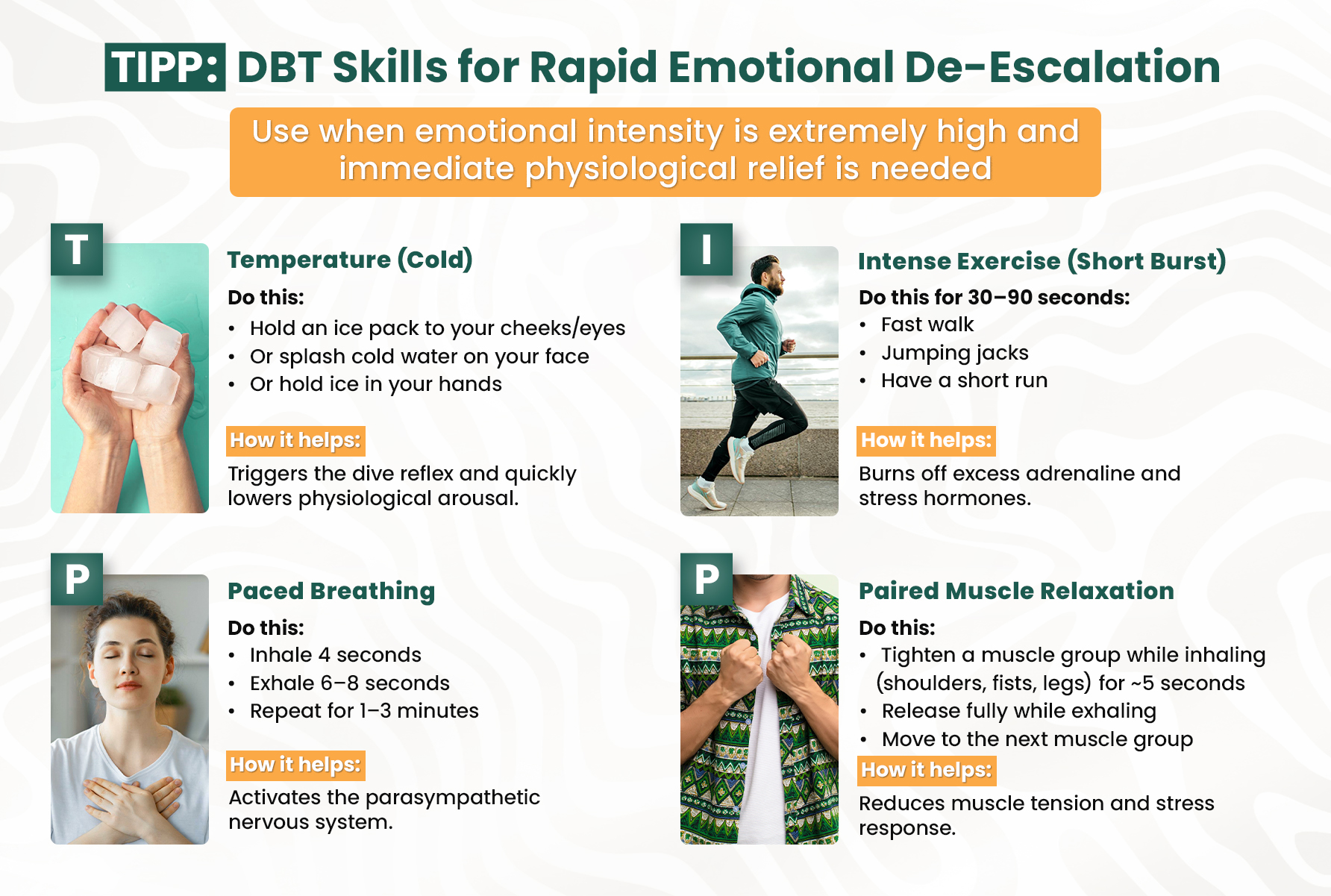
For immediate relief from high-intensity moments, techniques like the TIPP skills are effective. For grounding situations (moments when you feel overwhelmed or anxious), techniques like holding an ice pack or stepping outside for a minute are used to calm down.
Other coping techniques include self-soothing, distraction, and accepting that the moment is uncomfortable but temporary.
3. Emotion Regulation
The goal of emotion regulation is to:
- Identify the emotions
- Understand the emotions
- Try to figure out the reason behind them
- And why do I react like this?
In an emotional state, many patients say:
- “I don’t even know what I’m feeling half the time.”
- “My emotions bombard me, and I can’t separate one from another.
Emotion regulation teaches you how to break down your experience:
- What emotion am I actually feeling?
- What triggered it?
- How intense is it?
- Is the intensity of feelings appropriate?
Emotional regulation skills can decrease involuntary emotional responses and decrease emotional vulnerability. It teaches people practical cognitive techniques to improve their self-awareness so they notice emotional dysregulation signs early. This helps patients prepare themselves to intervene and react wisely sooner rather than later.
4. Interpersonal Effectiveness
This is one of the most practical parts of DBT. People with emotional vulnerability struggle to maintain healthy relationships.
The psychologists at CPG teach you:
- How to say no without feeling intense guilt
- Ask for reassurance without begging or pushing
- Set boundaries respectfully
- Direct communication instead of hinting or exploding
They help you break the cycle of:
Trigger → Feel embarrassed → Pull away → Panic → Apologize → Repeat
Interpersonal techniques like DEAR MAN, GIVE and FAST can help you get out of this loop. They may sound like acronyms, but when practiced, they will help you:
- Express your needs clearly
- Keep the relationship steady, even during conflict
- Respect yourself while staying connected to others

Key Types of Dialectical Behavioral Therapy
Dialectical Behavior Therapy is a structured treatment model that combines multiple components to help you develop real-world skills.
Individual Therapy
The main focus of individual theory is to understand current emotional reactions, recent situations, and patterns that interfere with daily functioning. The core is understanding what skills are needed to cope with these situations.
Skills Training
Skills are commonly taught in a group setting that functions more like a class than group therapy. The focus is to learn and practice DBT skills related to mindfulness, distress tolerance, emotion regulation, and interpersonal effectiveness.
Between-Session Coaching
Many DBT programs offer brief support outside scheduled sessions. It helps individuals apply skills learned during lessons in real emotional distress moments.
Consultation Team
DBT therapists have weekly meetings with DBT psychologists to review cases, solve challenges, and ensure a consistent and effective treatment approach.
Expert Insights
- The diary cards are the best tool to track your emotions, urges, behaviors, and the effective use of skills.
- It makes emotional patterns more visible that help you and your psychologist focus on specific difficulties rather than general impressions.
How to Manage Emotional Instability With DBT
The DBT psychologists at CPG maintain a balance between the emotional and rational mind at the same time, rather than trying to silence one or favor the other.
They teach how to make decisions when your emotions are high.
Emotional Mind
Inside the emotional mind, everything is so urgent. You feel like you have to act right away without giving your brain any chance to read the situation. This is what thoughts may sound like:
- “They didn’t reply, so something is wrong.”
- “I can’t handle this.”
- “I need to do something right now.”
Reasonable Mind
It’s the opposite of the emotional mind. It is based on logic, facts, reality, planning, and problem-solving. In this state, your brain will say:
- “There’s no proof that anything bad will happen.”
- “I’ve handled worse than this.”
- “Let’s slow down and think.”
But the problem is that when your emotions are high, you can’t bring your reasonable mind to work.
Wise Mind
A wise mind is the combination of both the reasonable and emotional mind (intuition and interpretation). Here, you will take what you know and combine it with what you want and find the best possible outcome. It doesn’t mean you will be calm all the time or won’t feel emotional at all. It will be like:
- “I feel hurt, and I don’t have all the information yet.”
- “This reaction makes sense, but I don’t have to act on it.”
- “I can pause before deciding what to do.”
And this is how your wise mind helps you make better decisions and handle situations more effectively without exploding emotions.
Learn to Handle Emotions With DBT Skills
Living with constant emotional intensity? The psychologists at CPG can help you teach DBT skills for tolerating distress, regulating emotions, and communicating needs more effectively via in-person and online visits.
How to Calm Yourself During Emotional Overload (ACCEPTS)
When emotions are too much to handle, thinking clearly is often not possible. In those moments, DBT uses distraction skills to help reduce emotional intensity long enough to prevent impulsive or harmful reactions.
ACCEPTS is a set of short-term strategies designed to calm individuals in high-intensity emotional situations. These skills do not fix the underlying problem. But for the time being, they shift attention away from overwhelming thoughts and feelings. The goal is to settle your nervous system without making things worse.
| Skill | What It Means |
| A – Activities | Do something that keeps you occupied for a short time, like going for a short walk. |
| C – Contributing | Do something kind or helpful for someone else, like cooking for someone. |
| C – Comparisons | Put the current moment in perspective, like comparing your current situation with the hard time you survived. |
| E – Emotions | Create a different emotion to shift how you feel, such as listening to your music that changes your mood. |
| P – Push Away | Temporarily set the problem aside and tell yourself you will come back to it later when you’re calmer. |
| T – Thoughts | Redirect your mind to something neutral, like playing a word game or counting objects/things. |
| S – Sensations | Use sensations to ground yourself, like holding something cold, tasting something that you love, and more. |
How Effective Is DBT?
Dialectical Behavior Therapy is one of the most well-researched treatments for emotional dysregulation. Especially people struggling with borderline personality disorder, self-injury, and chronic suicidal behavior.
Multiple randomized controlled trials have shown how DBT has contributed to fewer suicide attempts, reduced self-harm, fewer psychiatric hospitalizations, and better treatment retention. Research has also shown that DBT models are effective and have positive results for the treatment of substance use disorders, eating disorders, chronic depression, PTSD with emotional dysregulation, and adolescent self-harm, especially when treatment includes skills training alongside individual therapy.
Why Choose Capital Psychiatry Group for DBT
The psychologists at Capital Psychiatry Group offer structured DBT to teach patients skills and techniques to manage their reactions and intense emotions effectively.
- DBT-informed clinicians are trained in skills-based treatment
- A structured approach focused on real-world application
- Coordination with psychiatric services when needed
- Options for in-person and telehealth care, depending on clinical fit
Support When Emotions Disrupt Daily Life
Emotional reactions interfere with relationships, responsibilities, or decision-making? The DBT therapists of CPG provide tools to improve regulation and reduce the impact of intense emotional responses.
Final Words
Living with overwhelming and unpredictable emotions can significantly disturb your daily functioning. DBT offers a practical framework that helps you understand emotional patterns and teaches you to reduce harmful behaviors and respond to emotionally high situations more effectively. With consistent sessions with CPG psychologists, patients learn skills to manage their emotions and live a peaceful life.
Frequently Asked Questions
Do you accept insurance for DBT?
Yes. Capital Psychiatry Group accepts most major insurance plans, including Medicare and Medicaid.
Is DBT only for borderline personality disorder?
No. Originally, DBT was developed for people struggling with chronic suicidal ideation, self-harm, and especially BPD. But over time, it’s been adapted for many conditions, like emotional dysregulation, substance use disorders, eating disorders, PTSD with emotional instability, and adolescent high-risk behaviors.
Can DBT be done online?
Yes. DBT can be delivered through telehealth in many cases. CPG offers online DBT sessions to patients all across New Jersey.
Can DBT help with anger and relationship conflicts?
Yes. DBT includes specific skills for emotion regulation and interpersonal effectiveness that help manage anger and improve communication, and ultimately, conflicts in relationships.
How we reviewed this article:
CPG experts follow strict sourcing standards, using peer-reviewed research, academic institutions, and trusted medical journals. Only reliable, evidence-based sources are cited to maintain accuracy and integrity.
- https://www.sheppardpratt.org/news-views/story/dbt-101-what-does-dialectical-even-mean/
- https://centerforcbt.org/2023/04/26/dbt-tipp-skills/
- https://behavioraltech.org/teaching-give-skills-part-1/
- https://thewellnesssociety.org/accepts-dbt-skill-for-managing-intense-emotions/
- https://jamanetwork.com/journals/jamapsychiatry/fullarticle/209726
- https://pubmed.ncbi.nlm.nih.gov/25806661/
- https://pmc.ncbi.nlm.nih.gov/articles/PMC6007584/
- https://thewellnesssociety.org/dear-man-dbt-skill/
- https://resourcegrp.org/blog/the-fast-technique-in-dbt/
Our Review Standards
Our team regularly reviews health and wellness writings. Updates are made on the availability of new & authentic information.
Our Editorial Team
Clinical Adviser:
Author: